Having read the piece through and divided it into sections last week, the next job was to take those sections one at a time and methodically work through them. This involves testing out different fingering, deciding how ornaments should sound and playing the notes at a speed at which it is possible to get everything correct. Below the is first two pages of an edition from IMSLP for reference.
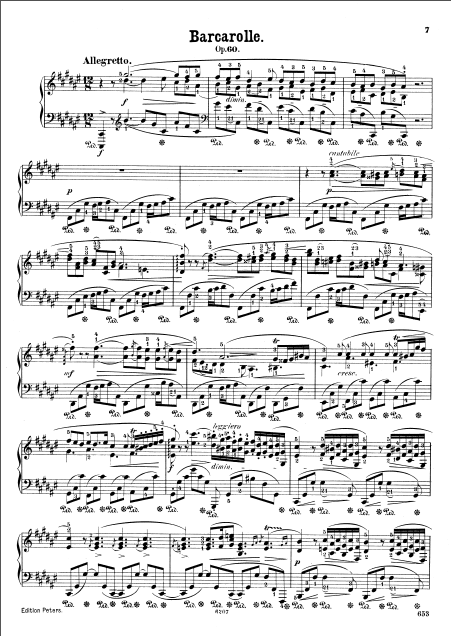
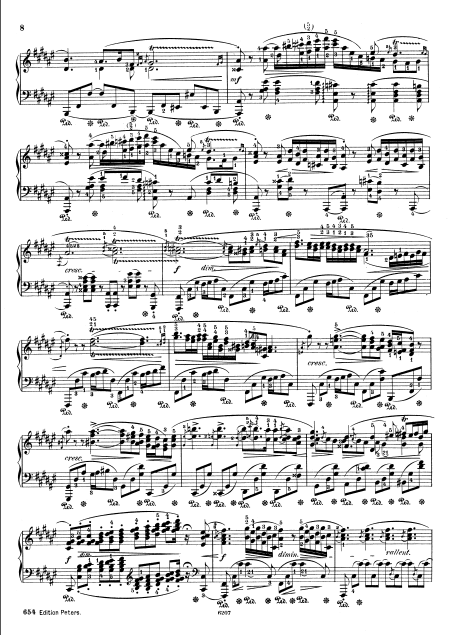
Bars 4 – 17
After the introduction, which I started last week, this was the first of my “sections”. It covers the introduction of the ostinato that is repeated twice later on, the first statement of the main melody and the first appearance of a descending sixth pattern which also recurs throughout the piece.
When played in the tonic key of F sharp major, the ostinato consists entirely of black notes. Both editions suggested the same fingering, which I found comfortable and effective. The two editions deviate from each other when the tune comes in; the Urtext suggests playing the A sharp and C sharp with fingers 2 and 3 (turning the 4th finger under to use 1 and 4 on the next chord), whereas the Lemoine recommends 2 and 4. The Urtext’s fingering was not uncomfortable, but I liked the simpler suggestion the the Lemoine offered, and was no less efficient.
As this piece is a barcarolle, one of the most characteristic features is the melody, which is often doubled in thirds or sixths. The melodic material of this form is typically that of a gondolier’s song, so it must be treated as a vocal part. The parallel notes are representative of two gondoliers singing together in unison; with that in mind it is important that both parts are given equal prominence.
The first finger swap of the piece is a tricky one, occurring on the fourth beat of bar 9. If you play the preceding notes with legato fingering (as is indicated), then you will end up on fingers 2 and 4 on an A sharp and C sharp. In order to keep the passage legato, this fingers must be swapped for 5 and 3, allowing the 2nd finger to be used on the F sharp of the next chord. This fingering is indicated in all the editions I have studied, and it is the most effective way to play the melody as it was indented.
There are several more finger swaps in the next two bars, however the next challenge comes in bar 10, in the form of two acciaccaturas played in sixths. Here i found it very easy to lose the bottom note of the ornament due to the stretch my hand has to make in oder to play both chords smoothly. The whole point of including the sixth in the ornament is to keep both voices parallel, without giving precedence to one over the other. I have been careful to remember this in practice, and will usually slow down accordingly.
In bar 11 I added in a finger swap in the lower part in order to play it legato. It involves stretching between finger 3 and finger on a D sharp and A sharp, then reaching down to a B with my newly released finger two. I have to twist my hand slightly in order to achieve it without releasing the top note, however it is not uncomfortable. At the end of bar 11 is the first of several trills, which works best if began on the upper auxiliary note (as Chopin had indented his trills). This also applies to the trill in the following bars, although in bar 13 it may be difficult at performance speed to fit more than three notes in to the semiquaver the trill is indicated on, at least without disrupting the tempo.
Bar 14 brings the first of a descending sixth passage. To accomplish this the book suggests changing hand position every two semi-quavers, using fingers 2+5 and 1+4 for the first and second chord, respectively. This works until the final chord, which is an octave G sharp, and requires a 3rd finger on the top note in order to prepare for the following chord.
Bars 17 – 22
The next couple of bars feature repetitions of the same physical movements previously used to realise the music up to that point. The most obvious recurring fragment is the descending sixth pattern (this time in the key of C sharp major and then B major), with some more trills thrown in for effect.
All of the trills are harmonised in the right hand with a held note in the lower part. In terms of execution, this is annoying, as trills are strongest when the thumb is incorporated to play one of the notes, and weakest when using two fingers next to one another.
In bar 20 the problem is compounded when the lower part begins to move during the trill, as opposed to simply being held as a pedal note. The instance of this in bar 20 involves a G sharp, F sharp, then another G sharp, all played underneath a trilling D sharp. This is difficult if the trill is played as abstract and undefined, as the performer will lose some of the feel for the tempo during the trill and the placing of the lower notes will be uncertain and imprecise. The solution is to give the trill a written value; in this case I assigned four trill notes per quaver, starting on the primary lower note (as the trill is preceded an acciaccatura on the auxiliary note).
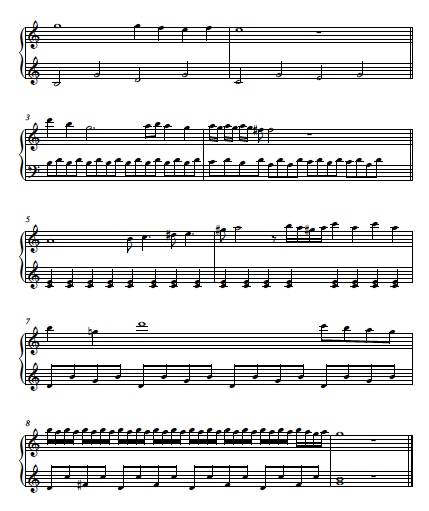
With this method you can even notate the ornament, something that I did recently for a student studying Mozart’s sonata in C major, K 545. The student was struggling with interpreting the ornaments, so by assigning them a value and notating it like a piece of music she was able to learn them without any further difficulty. Below is part of the transcription, it is of three separate passages in the exposition, separated by double bar lines.
While this is going on in the right hand, the left hand has it’s own troubles to overcome. The most problematic bar was bar 21, when the left hand splits into two separate voices for the first time in the piece. The chord consists of an F sharp and A sharp, which are held underneath an E, followed by an F sharp and then a D sharp. Unfortunately it is impossible to play the E and F sharp of the upper part smoothly whilst holding down the chord in the bass, they both require the thumb. However finger 2 is free to play the D sharp, a suggestion that the Urtext edition picks up on. A the end of the bar there is a similar passage, but it is possible to use the fingering 2-1-2.
Closing thoughts
I achieved my goal of working through the piece up until bar 35. I will save the analysis of bars 23-35 for the next post, as this one has become rather long, and I am not intending to progress onto the next part of the piece until next week. If I can get my video camera working this weekend then I will record myself playing up to bar 35 in its current state. The next part of the piece I will be tackling will be bars 84 – 93, as they share thematic material with the sections I am currently practicing.
Glossary
Acciaccatura – a grace note which does not take from the value of the main note, i.e. it is not played on the beat.
Auxiliary Note – a non-harmony note which is either a step above or below the primary note.*
Barcarolle – a piece of music composed in the style of a gondolier’s song, usually in double or quadruple compound time.
Finger-swapping – changing the finger being used on a held note without releasing the key.*
Ostinato – a short motif or melodic passage that is persistently repeated, usually at the same pitch.
Pedal Note – a note which is sustained through successive harmonies.
Tempo – directly translates into “time”; refers to the speed at which the music is played.
Trill – rapid alternation between two adjacent notes.