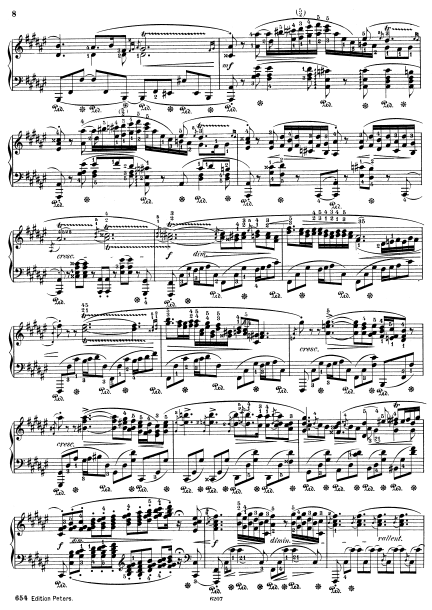
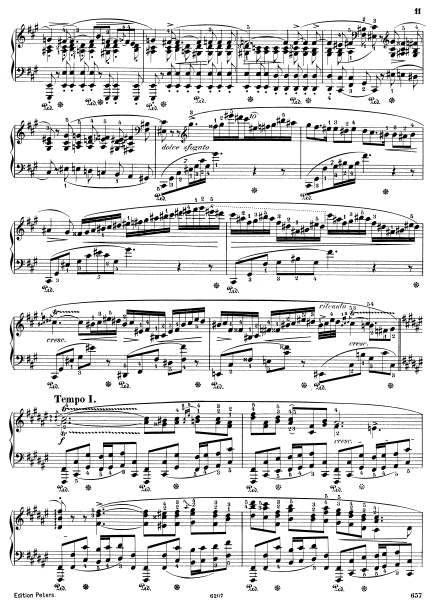
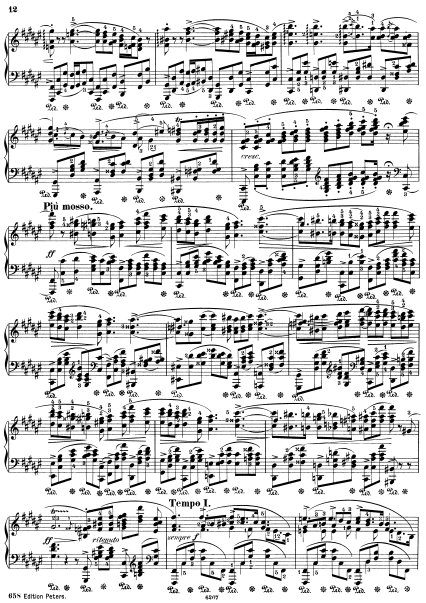
I had hoped to video my progress this week and write a commentary on it, however the battery in my camera has died and I am waiting on a new one, so it will have to wait until next week. Until then, here’s my breakdown of bars 23 – 35, followed by bars 84 – 92. As the two sections have the same melodic and harmonic structure, I will be comparing them simultaneously. I have shared the relevant pages from the sheet music below, from the Peters edition on IMSLP.
Bars 23 – 27 & 84 – 87
At bar 24 and 84 the main melody begins with a double trill, which involves the hand performing two trills at once. The upper trill between a C sharp and a D sharp is executed with fingers 5 and 3, as the 4th and 5th fingers naturally produce the weakest trill. The lower trill between an A sharp and a B in executed using fingers 1 and 2, with the 1st finger tucked under the 2nd onto the B so as to stimulate a natural rocking motion with the hand.
The preceding double trill in bar 23 is harder to execute as the upper part (C double sharp and D sharp) can only be achieved with fingers 4 and 5. Slow practice with an assigned value for the trill was the solution, in this case playing in in demisemiquavers, i.e. four trill notes per quaver. It may be worth my while to look at some technical exercises (or even coming up with an appropriate one myself) to strengthen this movement, but I will see how well I can learn it with my current technique.
Following on from the double trill, bars 84 and 85 continue the tune in thirds as it is first heard in bar 7, whereas in bar 25 the tune is embellished with a descending semiquaver third pattern. The most obvious way to play these thirds is to use 5-3, 4-2 and then 3-1, however both editions suggest using 4-1 and then 3-2 in place of 4-2 and 3-1. This is a much more natural movement is is very common in third passages with lots of black notes.
Bar 26 begins with another double trill, and bar 27 has more semiquaver thirds, this time jumping between the soprano and alto register. When writing for the piano, composers often write passages that would be difficult for a singer to simulate that difficulty on a piano (for example, jumping from the tonic to the leading note). This is the case here, as the “jumps” don’t actually require you to move your hand. Some finger swapping is suggested to keep the top line smooth.
Bars 28 – 30 & 88 – 90
These two bars are both built around seventh chords and their resolutions. In bar 28/88 Chopin adds the seventh to the tonic chord of F sharp major, resolving it to B major. In bar 29/89 he repeats the passage a tone higher, with a G sharp major seventh chord resolving to C sharp major.
The rhythm of the ostinato is split between both hands in these bars. for the first six beats the left hand plays it as usual, however in the next six beats the semiquaver rhythm is heard in the right hand whilst the left simply plays quavers.
One difference between the two sections that I haven’t talked about is when the ostinato is doubled in octaves from bar 83. The simplest way to play this would be to use fingers 1 and 5 for every chord, however it is possible to incorporate fingers 3 and 4 to create a smoother effect. The best place to do this would be during the F sharp, G sharp and A sharp, written as two semiquavers followed by a quaver. The music suggests using 1 and 5 on the F sharp octave, 4 and 5 on the G sharps and 3 and 5 on the A sharp. By doing this, it work to create the illusion of legato playing, even though it is only in the lower part.
Bar 30 – 31 & 90 – 91
Bars 30/90 and 31/91 are probably among the trickiest in the piece. This is because the different lines are woven closely together, require several difficult finger-swaps and culminate in a trill only possible with fingers 4 and 5.
The first major difficulty is at the end of bar 30, during the penultimate quaver. An acciaccatura on a D sharp and B before the chord of C sharp, B sharp and A sharp means that all five fingers have to be used in order to play it legato. Furthermore, the D sharp in the acciaccatura is tied to the chord note, which can be very confusing for the hand. It is the kind of thing that Oscar Beringer’s Daily Technical Studies are useful for, and I may have a look through it again if bar 30/80 proves to be difficult.
In bar 31/91 the tune begins in the middle voice for the first two chords before transitioning into the higher voice during the third chord. It is another occasion where all five fingers are required at the same time, and I will spend time making sure my hand is weighted correctly to emphasise the right part at the right time.
The final three beats begin with a trill on an F sharp quaver. Unfortunately it is only possible to do this with fingers 4 and 5, as 1 and 2 are needed to play the chord in the lower part and 3 has to be ready to play an E sharp straight after the trill. A 3rd finger slide here would not work as it is too quick to allow for the necessary control and would result in a bump on the E sharp. 4th/5th finger trills were something that I struggled with in Op. 53, so I will take extra care here to make sure they don’t become a problem again.
Incidentally, in the Urtext edition the ornament at the end of bar 31 is indicated to be a trill, however the ornament at the end of bar 91 is a mordent. In the Henry Lemoine edition both ornaments are trills. For the sake of consistency I have opted to play them both as trills; the Urtext explains that the mordent is from the French and German first editions, however in the English first edition (all published simultaneously with the French and German) it is written as a trill.
Closing Thoughts
After the climatic ascending chordal passage in bar 33 the piece goes back to the descending sixth pattern that I worked through last week. Several F sharp major chords mark the end of the section, which finishes with a tierce de Picardie. This is all easy enough and won’t need too much work.
Of the two sections I have been playing through this week I have found the earlier section (bar 23 – 35) harder. This is because the only extra difficulty of the later section the the addition of octaves to the left hand and much of the right hand. This gives the section a grander character, but doesn’t require as much thinking about as the embellishments of the earlier section. Aside from the octaves all the other difficulties of the later section are shared with the earlier one.
With any luck my old camera should be up and running this week, so I will be able to record myself practicing in time for the next post. In tackling 84 – 92 I did more than I expected to this week, so I won’t be trying any new sections next week and will instead focus on refining what I have already learned.
Glossary
Acciaccatura – a grace note which does not take from the value of the main note, i.e. it is not played on the beat.
Double trill – two trills occurring in simultaneously in parallel motion.
Finger-slide/slide – a technique for playing smoothly with one finger by sliding the finger from a black note to a white note.
Finger-swapping – changing the finger being used on a held note without releasing the key.
Leading note – the seventh degree of a given scale.
Ostinato – a short motif or melodic passage that is persistently repeated, usually at the same pitch.
Tierce de Picardie – a change of tonality in the final chord of a cadence.
Tonality – the key of the piece and the sound it produces.
Tonic – the first degree of a given scale.
Trill – rapid alternation between two adjacent notes.